AI & FDA Compliance

Are you confident the AI tools you’re using in your regulated environment are compliant?
Artificial Intelligence (AI) in FDA-Regulated Systems:
Practical Governance for AI-Assisted Decisions
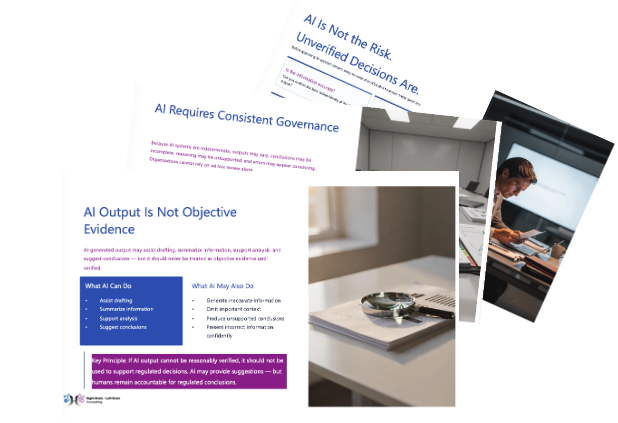
AI is not inherently noncompliant.
The real risk is using unverified AI output to support regulated decisions without appropriate review and governance.
WHAT ORGANIZATIONS ARE MISSING
Most organizations are already using:
- AI copilots
- AI-assisted drafting
- embedded AI features
- AI-supported decision tools
BUT many still lack:
- defined review expectations
- AI governance procedures
- risk-based verification approaches
- procedural consistency

THE KEY REGULATORY SHIFT
Traditional software validation is based on predictable, deterministic behavior where the same input consistently produces the same output.
AI systems work differently. Because AI is probabilistic, outputs may vary, important information may be omitted, and unsupported conclusions may still appear convincing or well-written.
As a result, organizations cannot rely on blind acceptance of AI-generated output.
Instead, review rigor, verification, procedural governance, and human accountability become critical controls for ensuring regulated decisions remain accurate, defensible, and appropriately governed.
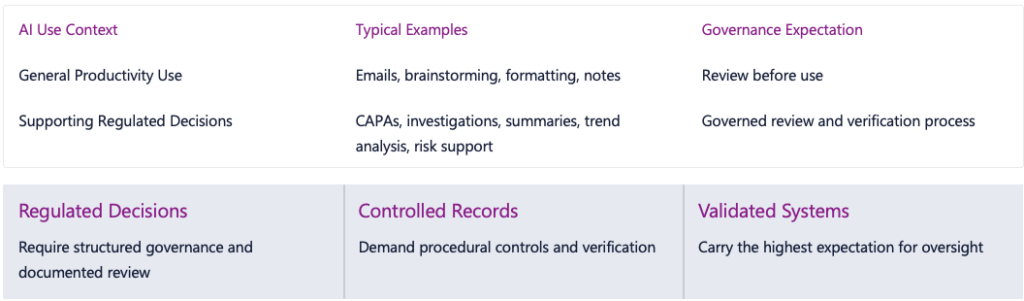
TWO TYPES OF AI USE
Understanding the context of AI use is essential. The closer AI gets to regulated decisions, controlled records, or validated systems, the greater the expectation for governance and procedural control.
WHY PROCEDURES MAY NEED TO EVOLVE

Most QMS procedures were written before:
- AI copilots
- embedded AI suggestions
- AI-assisted decision support
Organizations may need to define:
- acceptable AI use
- review expectations
- verification requirements
- documentation expectations
- approval responsibilities
We help organizations apply AI in regulated environments without compromising quality system expectations, defensibility, or process control.
Download our practical guidance for applying AI in regulated QA/RA environments without compromising compliance expectations.