See How It Works
The New Product Concept Generator combines AI-driven ideation with strategic market and regulatory insights to accelerate early-stage innovation. Using company-specific inputs — such as R&D focus, available technologies, budget constraints, or target markets — the app generates multiple product concepts, each supported by feasibility data, risk indicators, and a path-to-market roadmap. It’s designed to help teams move from idea to validated concept faster and with greater confidence.
ROI /Value
Traditional product ideation cycles can take weeks of brainstorming and manual research before a viable concept emerges. The New Product Concept Generator compresses this process into hours, delivering data-backed innovation options with clear feasibility insights and visuals — enabling faster decisions, reduced risk, and improved R&D efficiency.
Features
- AI Ideation Workshop: Generates 3–5 new product concepts aligned with company goals
- Deep Dive on Selected Concept: Explores differentiation, use cases, and customer value
- Competitive Landscape & Technology Trend Scan: Identifies whitespace and innovation opportunities
- Feasibility & Risk Snapshot: Evaluates readiness across technical, market, and operational dimensions
- Regulatory & Compliance Lens: Flags requirements early to de-risk design
- Materials & Manufacturing Options: Suggests viable sourcing and production paths
- Cost & ROI Estimate: Projects potential investment and return window
- Concept-to-Market Roadmap: Maps out milestones from prototype to launch
- Visual Concept Render: Produces AI-generated imagery of the proposed product for presentation or investor review
Take your time and check out how the conversation works.
For: (DEMO)Acme MedTech — IDEATION WORKSHOP (R&D Engineer)
Snapshot (prefill)
- Offerings: Precision injection-molded polymer housings for single-use medical disposables; small-scale assembly.
- Industry: Medical devices (Class I–II disposable components)
- HQ / Geos: Minneapolis, MN — US, EU sales focus.
- ICP / Segments: OEM medical-device manufacturers needing sterile, high-tolerance polymer parts; contract manufacturers requiring design-for-manufacture.
- Competitors: SteriPlast, MoldMed Inc., Regional contract molders.
- Signals: Rising demand for single-use, connected disposables; supply-chain pressure on medical-grade resins.
- Sources: Demo profile (prefill). ⚠ Browsing OFF — assumptions made from typical med-device CM market.
Priorities & Constraints
- Selected outcomes: Apply new technology; Expand product line.
- Constraints: Small R&D budget (<$100k POC), 6–9 month time-to-first-revenue target, regulatory (EU MDR / FDA guidance for disposables).
Ideation — 3 candidate concepts (brief table)
|
# |
Concept |
One-line |
Feasibility |
Market Potential |
Strategic Fit |
Total |
|---|---|---|---|---|---|---|
|
1 |
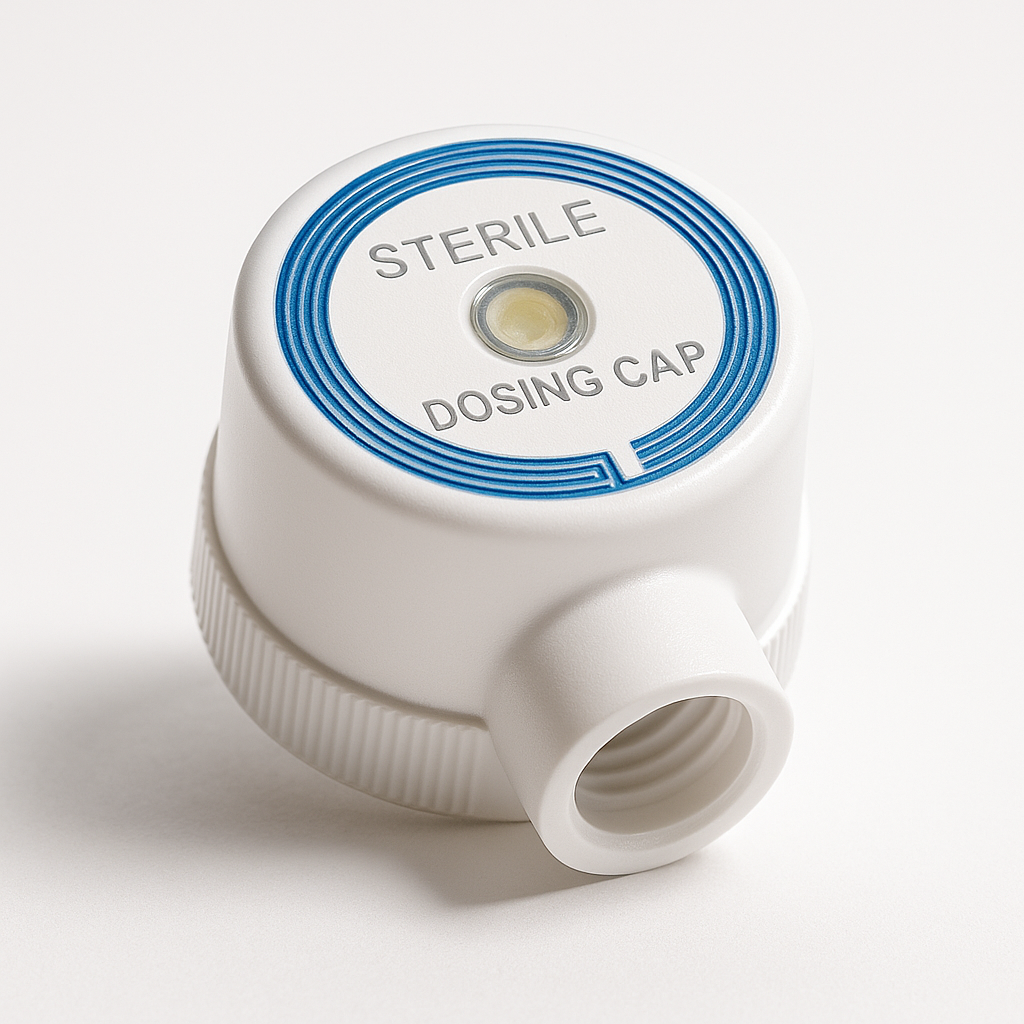
Smart Sterile Dosing Cap |
Single-use injection-molded cap with low-cost RFID/visual indicator that tracks dose event & sterility state. |
M (2) |
H (3) |
H (3) |
8 |
|
2 |
Low-Cost Biocompatible Seal Insert |
Over-molded micro-seal insert using recycled medical-grade polymer to replace expensive silicone seals. |
L (1) |
M (2) |
H (3) |
6 |
|
3 |
Toolless Assembly Snap Housing |
Re-designed housing geometry for automated, tool-free assembly to reduce labor/time on SMT-like devices. |
M (2) |
M (2) |
M (2) |
6 |
(Scoring: H=3, M=2, L=1. Higher total = better initial priority.)
Recommendation: Start with Concept #1 — Smart Sterile Dosing Cap (highest total, strong commercial hook with modest tech lift).
Deep Dive — Smart Sterile Dosing Cap (selected_concept)
Refined Brief
- Problem: Clinicians and patients lack low-cost, reliable ways to confirm that a single-use dose cap/port was used or breached; traceability for single-use devices is limited.
- Solution: A disposable dosing cap molded from standard medical polymer with a passive RFID or visual chemical indicator embedded during molding that records/indicates a single-use event and sterility breach; readable by a low-cost handheld reader or smartphone NFC (where applicable).
- Value: Reduce misuse, improve traceability, enable OEMs to offer “usage-verified disposables” to increase value and recurring sales.
Core Features
- Injection-molded cap with integrated micro-encapsulated color-change indicator (sterility breach) or passive RFID tag cavity;
- Standard footprint to fit existing host devices;
- Manufacturing-ready design (single-cavity overmold or insert-mold process);
- Optional peel-off data label (lot + expiry) for traceability.
Enabling Technologies / IP Notes
Consider patent search for dosing-cap indicators and RFID-inserted disposables (freedom-to-operate).
OSHA safety awareness and PPE use due to equipment and tool handling
Passive RFID / NFC tags (low-cost — $0.05–$0.20 at scale) or micro-encapsulated indicators (chemical color-change tech).
Target Users / Personas
- OEM QA Manager (primary buyer): cares about traceability, compliance.
- Clinical Procurement Lead (secondary buyer): cost per unit, shelf stability.
- Field Nurse / End User (user): needs obvious sterility indicator and ease-of-use.
90-Day GTM Quick Plan (POC → Pilot)
Weeks 11–12 — Pilot Partner: Ship 100 pilot caps to 1 OEM partner for functional validation/use-case feedback.
Weeks 1–2 — Design & Feasibility: CAD concept, choose indicator tech (RFID vs visual), BOM estimate.
Weeks 3–6 — Proto & Bench Testing: 10–50 prototypes via rapid tooling; bench test for indicator reliability and sterilization survival.
Weeks 7–10 — Regulatory Checkpoint: High-level review vs FDA guidance for disposables (class status), prepare documentation checklist (biocompatibility, sterilization validation).
Feasibility / ROI Snapshot (ballpark)
- Unit cost at scale (estimate): $0.10–$0.50 (indicator dependent).
- Target ASP premium to OEM: $0.10–$0.50 per cap (value-add for traceability).
- POC budget: ~$40k (rapid tooling + components + testing).
- Payback: If sold as $0.20 premium and OEM uses 500k units/yr → incremental revenue $100k/yr; margin depends on tooling & fixed costs.
Early Risks & Mitigations
- Risk — Indicator fails sterilization: test alternative sterilization cycles; choose indicator chemistries rated for EtO or gamma.
- Risk — RF tag reading reliability in medical environment: pilot with typical housings; choose frequency/type validated for proximity.
- Risk — Regulatory classification ambiguous: early consult with regulatory specialist; classify as accessory vs device based on host device relation.
Quick actions for Acme MedTech & Smart Sterile Dosing Cap
- Build GTM (detailed launch plan & pricing).
- Compare another idea (return to ideation table).
- Creative Ideation (brochure copy + visuals for pilot).
- Return to Menu.